This article was written by Matin Mirshafiei and approved by Dr. Mona Negm.
Subcision for Acne Scars: 7 Powerful Facts Every Patient in Muscat Should Know
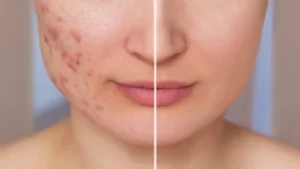
If you’ve tried creams, peels, and serums for your acne scars with little to show for it, you’re not alone. Many patients who walk into our clinic in Muscat have spent years trying to smooth out depressed scars; only to find that the real issue runs deeper than any topical product can reach. That’s exactly where subcision comes in.
1. What Is Subcision: And Why Does It Work?
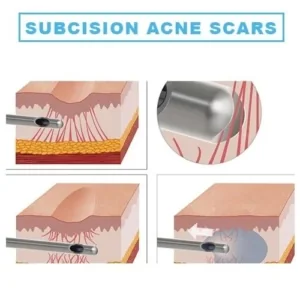
Subcision is a minimally invasive dermatological procedure specifically designed for depressed scars, particularly rolling and atrophic acne scars. Using a fine needle inserted just beneath the skin’s surface, the doctor cuts through the fibrous bands anchoring the scar tissue to deeper layers. Once those bands are released, the skin lifts naturally, and collagen production begins filling the space from below.
It’s one of the most evidence-backed approaches to scar reduction available today, with strong clinical data supporting its effectiveness for depressed acne scars. You can review the clinical research directly on PubMed.
2. Which Scar Types Respond Best?
Not every scar is a good candidate. Subcision works best for:
Rolling scars: the most common acne scar type in our Muscat patients
Atrophic scars: where skin tissue is lost
Boxcar scars: in select cases, depending on depth
Some injury or surgical scars
It is not suitable for raised (hypertrophic or keloid) scars. A proper skin assessment is essential before recommending treatment.
3. What Happens During the Procedure
The process is straightforward. A local anaesthetic is applied to numb the area. A specialised needle (often a Nokor needle) is then inserted beneath the scar and moved in a fan-like motion to release the fibrous tethering bands. You may hear or feel a soft “popping” sensation; this is completely normal and actually a good sign. Each session is done in one appointment, and its length depends on how many scars are being treated.
4. Subcision Is Most Powerful When Combined
At Azura Clinic, we rarely use subcision in isolation. Combining it with complementary treatments amplifies and prolongs your results significantly. Common pairings include:
PRP (Platelet-Rich Plasma): to accelerate healing and boost regeneration
Gel Filler: to volumise and support the newly lifted scar area
Your doctor will design a personalised protocol based on your scar pattern, skin tone, and treatment goals, especially important in Oman’s climate, which can affect skin healing and pigmentation.
5. Recovery Is Manageable
Most patients experience mild swelling and bruising that settles on its own after treatment. This is temporary and a normal part of the healing process. Sun protection is essential during recovery; something we always emphasise strongly for patients in Muscat given the year-round UV intensity here.
6. Realistic Results: And When to Expect Them
Visible improvement typically begins in the weeks that follow, as collagen remodelling gets underway. Full results are usually seen once the collagen has finished remodelling. The scar release itself is permanent, though some patients benefit from a second session for optimal outcomes. The American Academy of Dermatology recognises subcision as a well-established option in acne scar management protocols.
7. Subcision vs. Other Treatments: A Quick Comparison
Subcision: Low invasiveness, short downtime, best for rolling and atrophic scars
Microneedling: Very low invasiveness, minimal downtime, suits superficial texture concerns
Laser Resurfacing: Medium–high invasiveness, the longest downtime of the three, targets deep or pigmented scars
For many patients in Oman with darker skin tones (where laser resurfacing carries a higher risk of post-inflammatory pigmentation) subcision is often the safer, equally effective first choice.
Are You a Good Candidate?
If you have depressed acne scars that haven’t responded to creams or light treatments, subcision may be the missing piece in your skin journey. Our specialist doctors at Azura Clinic in Muscat will evaluate your scars, skin type, and medical history before recommending any procedure.