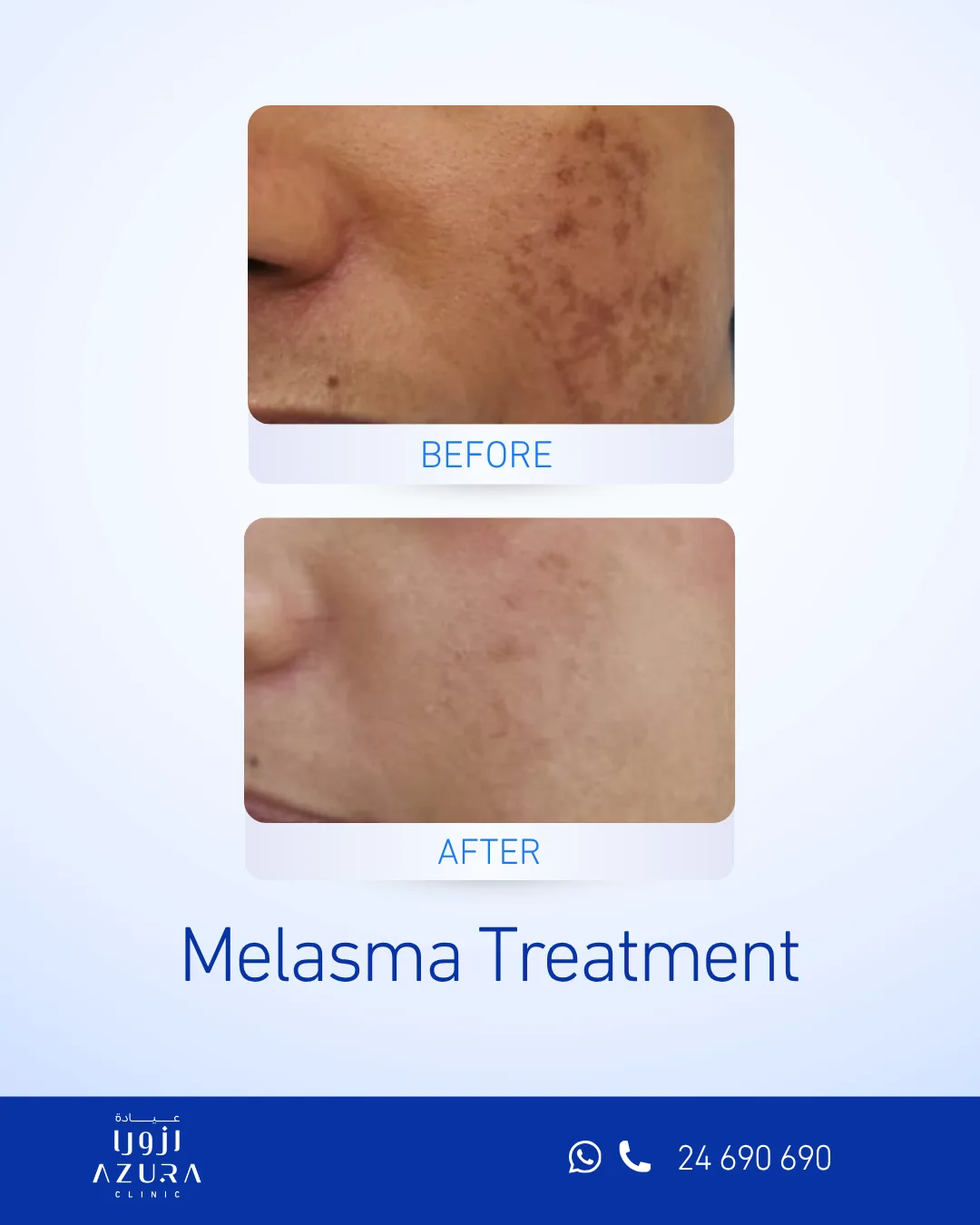
Melasma Treatment

Melasma treatment for dark spots and pigmentation at Azura Clinic Muscat Oman
Published at 29 October 2025
Views 341
Author Matin Mirshafiei
Last Update July 16, 2026

What Is Melasma Treatment?

Melasma is a skin condition that causes dark, uneven patches — most commonly on your cheeks, forehead, nose, and upper lip. It’s triggered by a combination of sun exposure, hormonal shifts, and genetics, and it’s especially common in Oman due to high UV levels year-round.

While melasma is completely harmless, it can affect how you feel about your skin. Melasma treatment in Muscat at Azura Clinic is a medically guided approach designed to lighten those patches, even your tone, and restore natural radiance — safely and effectively.

Every treatment plan at Azura Clinic is built around your unique skin type and the specific depth of your pigmentation. There is no one-size-fits-all approach here.

How Does It Work?

Melasma forms when melanocytes — the cells that produce skin colour — become overactive and deposit excess pigment into the skin. Effective treatment means targeting that overproduction at its source.

At Azura Clinic, we use a combination of proven therapies tailored to your skin:

  • Laser Therapy (Pico Laser or Meladeep Laser): Breaks down deep pigmentation with precision while stimulating collagen renewal beneath the surface.
  • Medical-Grade Chemical Peels: Gently resurface the skin to lift surface-level dark spots and improve overall clarity.
  • Topical Brightening Formulas: Prescription-strength creams that suppress excess melanin production between sessions.
  • Post-Treatment Skincare: Soothing, brightening creams — including Meladeep Post Cream — to support your skin’s recovery and extend results.

This layered approach addresses melasma at multiple levels, which is why it delivers more consistent, lasting results than a single treatment alone.

Who Is a Good Candidate?

If you have persistent dark patches that haven’t responded to over-the-counter products, you are likely a strong candidate for professional pigmentation treatment in Muscat.

This treatment is well suited for you if you:

  • Have stubborn dark spots or uneven skin tone on your face
  • Notice pigmentation that worsens with sun exposure or hormonal changes (such as pregnancy or contraceptive use)
  • Have tried brightening creams without satisfying results
  • Are looking for a medically supervised dark spots treatment in Oman

Our specialist doctors will assess your skin thoroughly before recommending any treatment — your safety always comes first.

What Results Can You Expect?

Most patients notice a visible improvement in skin brightness and a reduction in dark patches after their initial sessions. With each visit, pigmentation fades further and your skin tone becomes progressively more even.

Beyond lightening, you can expect smoother skin texture, improved radiance, and a reduction in the likelihood of melasma returning — especially when you follow your prescribed home care plan. Skin brightening in Muscat is entirely achievable with the right protocol.

Results do vary depending on skin type, the depth of pigmentation, and lifestyle factors like sun exposure. Your doctor will give you a realistic picture during your consultation.

Why Azura Clinic in Muscat?

Azura Clinic is Oman’s leading dermatology and aesthetics clinic — and the recipient of the Best Brand CX Oman 2025 award. Our team brings international expertise directly to Muscat, using only medical-grade technology and evidence-based protocols.

When it comes to melasma, experience matters. Our doctors understand the skin tones and environmental triggers most common in Oman, which allows us to personalise your treatment far more precisely than a general clinic ever could.

We also believe in full transparency — you’ll always understand exactly what we’re doing and why. Explore more about our approach on our About Us page, or browse our current special offers to see how we can make your care more accessible.

Aftercare Tips

Great results come from great aftercare. Here is what your skin needs after each session:

  1. Apply a broad-spectrum SPF 50+ sunscreen every single morning — this is non-negotiable for melasma management.
  2. Use the soothing and hydrating creams recommended by your specialist.
  3. Avoid hot showers, steam rooms, and saunas for at least 24 hours after treatment.
  4. Do not pick, scratch, or manually exfoliate any peeling skin.
  5. Skip makeup for the first 24 hours to allow your skin to recover undisturbed.
  6. Stay well hydrated and follow your personalised Melasma Homecare Plan consistently.

Before treatment, avoid sun exposure and tanning for at least one week, and stop using retinoids or exfoliating acids five days prior. Arrive with clean, makeup-free skin so your doctor can assess it accurately.


5/5 - (20 votes)


Before / After Treatment

Before Treatment Instructions
🔷 Avoid sun exposure and tanning for at least one week.
🔷 Stop using retinoids or exfoliating acids 5 days prior.
🔷 Arrive with clean, makeup-free skin.
After Treatment Instructions
🔷 Use soothing and hydrating creams recommended by our specialists.
🔷 Always apply broad-spectrum sunscreen (SPF 50+) daily.
🔷 Avoid hot showers, saunas, and makeup for 24 hours.
🔷 Do not pick, scratch, or exfoliate peeling skin.
🔷 Stay hydrated and follow your prescribed Melasma Homecare Plan.


Before and After Instructions (PDF) – Click to Download


FAQs
1
Melasma Treatment at Azura Clinic in Muscat usually ranges from OMR 25 to OMR 77, with the final cost varying by each patient’s pigmentation level, skin condition, treatment needs, and doctor’s assessment.
2
These technologies deliver controlled energy into the skin that breaks down excess pigment clusters without harming the surrounding tissue. The fragmented pigment is then gradually cleared by the body's natural processes, revealing more even-toned skin underneath. At Azura Clinic, the specific wavelength and intensity used are carefully selected to suit your skin type and the depth of your pigmentation, which is essential for safe results on darker skin tones common in Oman.
3
Most patients describe the experience as very tolerable — you may notice a gentle warming sensation or light tingling during energy-based treatments. Chemical peels can cause a brief, mild stinging that settles quickly. Our team at Azura Clinic uses soothing preparations and works at a careful pace to keep you comfortable throughout.
4
Some patients notice a gradual lightening of patches within a few weeks of beginning treatment, while others see more significant change after several sessions. Results build progressively rather than appearing overnight, so consistency is key. Combining professional treatment with the right home skincare and daily sun protection accelerates your outcome considerably.
5
Melasma is a chronic condition with a tendency to recur, particularly if hormonal triggers remain or sun exposure is not managed carefully. However, patients who commit to daily broad-spectrum SPF use, avoid peak sun hours, and attend maintenance reviews see much longer-lasting results. At Azura Clinic, we work with you on a long-term skin health plan, not just a one-time fix.
6
Yes — when performed by experienced practitioners using the correct protocols, melasma treatment is safe for all skin tones, including the medium-to-deep complexions common across Oman and the wider Gulf region. Choosing the wrong treatment or energy level on darker skin can risk post-inflammatory hyperpigmentation, which is why a thorough skin assessment before starting is non-negotiable. The team at Azura Clinic has extensive experience treating a diverse range of skin tones safely and effectively.
7
You are likely a good candidate if you have visible brown or greyish facial patches that have not responded well to over-the-counter brightening products, and if you are not currently pregnant. Both men and women develop melasma, though it is more common in women, especially after pregnancy or while using hormonal contraception. A consultation at Azura Clinic will confirm whether professional treatment is appropriate for your specific situation.
8
Treatment is generally postponed during pregnancy or breastfeeding, as certain active ingredients and energy-based therapies are not recommended during this period. Active skin infections, very recent sun damage, and certain photosensitising medications may also require a delay. Your Azura Clinic doctor will review your full medical history during your consultation to ensure it is safe to proceed.
9
In the days leading up to your session, avoid prolonged sun exposure and stop using any harsh exfoliants, retinoids, or active acids unless instructed otherwise by your practitioner. Arriving with clean, product-free skin and well-hydrated skin generally supports a better treatment response. Your Azura Clinic team will give you a specific pre-treatment checklist tailored to whichever procedure you are having.
10
Recovery is typically minimal — most patients return to their normal routine the same day or the following day. You may experience temporary mild redness, slight sensitivity, or a faint darkening of the patches before they shed and lighten, all of which are normal responses. In Oman's strong sun, strict SPF use immediately after each session is essential to protect the treated skin and preserve your results.
11
Melasma is one of the more complex pigmentation conditions to treat, and it requires medical expertise — not just aesthetic equipment. At Azura Clinic, your treatment is overseen by qualified doctors and dermatology-trained practitioners who assess pigment depth, skin type, and hormonal factors before building a tailored plan. This clinical approach significantly reduces the risk of complications and gives you a much higher chance of achieving lasting, even results.
12
Azura Clinic offers a personalised combination approach that may include medical-grade topical brightening agents, chemical peels, laser treatments, and targeted light therapies. Because melasma varies from person to person, our dermatologists assess your skin tone, pigment depth, and lifestyle before recommending a plan. There is no single universal protocol — your treatment is built specifically around you.
Comments

Leave a Reply

Your email address will not be published. Required fields are marked *